Our Framework
Trust Before Tools
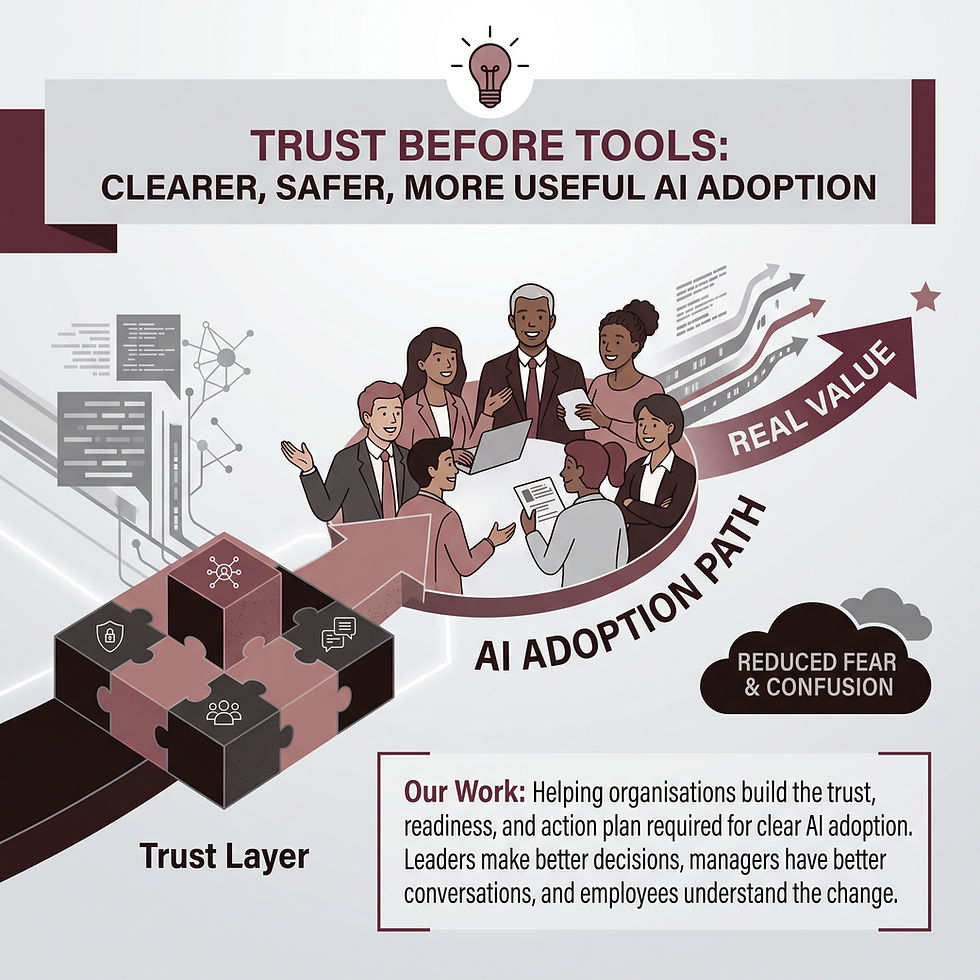
The Trust Before Tools Framework helps scaling companies build the cultural, leadership, and operating conditions required for AI to actually take root.
It is designed for CEOs, HR leaders, and executive teams who know AI matters, but do not want to create confusion, resistance, or tool fatigue across the business.
The framework looks at AI adoption through three practical layers:
Trust: Do people believe this change is being led with clarity, fairness, and responsibility?
Readiness: Does the organization have the leadership habits, communication norms, and decision rules needed to adopt AI well?
Action: Are there clear use cases, simple guardrails, and practical next steps teams can actually use?
This is not AI theater.
This is adoption work.
Most AI initiatives fail not because the technology is flawed, but because the human foundation hasn't been built. We believe that for AI to create real value, you must solve for people, culture, and readiness before you flip the switch on the software.
Trust
The foundation of AI adoption. Trust answers human questions about fairness, judgment, and responsibility before tools are introduced.
Readiness
Whether the organization has the leadership habits, communication norms, and systems required to use AI tools responsibly and at speed.
Action
Converting findings into focused progress: identifying high-value use cases and equipping managers to lead the adoption process.
Layer 1: Trust
Trust is the foundation of AI adoption.
If employees believe AI is being introduced to replace them, monitor them, or quietly devalue their judgment, they will not engage honestly. They may comply on the surface, but they will hesitate, avoid, or work around the initiative.
That is where many AI rollouts start to break.
Trust answers the human questions first:
-
Why are we using AI?
-
What does this mean for my role?
-
Where is human judgment still required?
-
What will leadership do with the productivity gains?
-
What is safe to try, and what is not?
-
When those questions are left unspoken, people fill the silence themselves.
Usually with fear.
la
The Trust layer helps leaders clarify intent, reduce ambiguity, and create the conditions where people can engage with AI honestly instead of defensively.
Layer 2: Readiness
Once trust is visible, the next question is readiness.
Readiness is not about whether the company has access to AI tools. Most teams already do.
Readiness is whether the organization has the habits and systems to use those tools well.
We look at questions like:
-
Are leaders aligned on what AI should and should not do inside the business?
-
Do managers know how to talk about AI without creating panic or hype?
-
Are teams encouraged to experiment responsibly?
-
Do decision-making norms support speed, learning, and transparency?
-
Are there cultural blockers slowing adoption before the work even begins?
This is where HR becomes central.
AI adoption is not only a technology project. It is a leadership, culture, communication, and capability project. HR leaders are often the ones closest to the real adoption risks because they see the gap between executive ambition and employee experience.
The Readiness layer makes that gap visible.
Layer 3: Action
The Action layer converts findings into practical next steps. The goal is to create focused progress by identifying use cases, building roadmaps, and equipping managers to lead better conversations that people can understand and follow.
How We Work
We begin by diagnosing the conditions around AI adoption, not just the tools being considered.
That means looking at leadership alignment, employee trust, cultural readiness, communication gaps, and the way work actually happens inside the organization.
From there, we help you identify what is working, what is blocking progress, and what needs to happen next. The result is a practical path forward that your leaders can act on and your teams can trust.
No jargon. No generic AI roadmap. No pretending software alone will fix a human adoption problem.
Why mid-market executives must prioritize cultural resilience over speed when integrating generative AI tools.
What This Helps You Avoid
The Trust Before Tools Framework is built to help companies avoid the most common AI adoption traps:
-
Buying tools before defining the real use case
-
Launching AI initiatives without leadership alignment
-
Creating employee fear through vague communication
-
Treating resistance as stubbornness instead of signal
-
Moving too slowly because no one owns the adoption work
-
Moving too fast without the trust and guardrails required
Leaving HR out of a change that directly affects people, roles, skills, and culture
AI adoption works better when leaders stop asking, "What tool should we buy?" and start asking, "Is our organization ready to use this well?"
That is the better starting point.
The Outcome
When trust comes before tools, AI adoption becomes clearer, safer, and more useful.
Leaders make better decisions. Managers have better conversations. Employees understand what is changing and why.
The business can move faster without creating unnecessary fear or confusion. That is the work: helping organizations build the trust, readiness, and action plan required for AI to create real value.
If your company is exploring AI and you are not sure whether your people, leaders, or culture are ready for it, start with the trust layer. The tools can come next.